
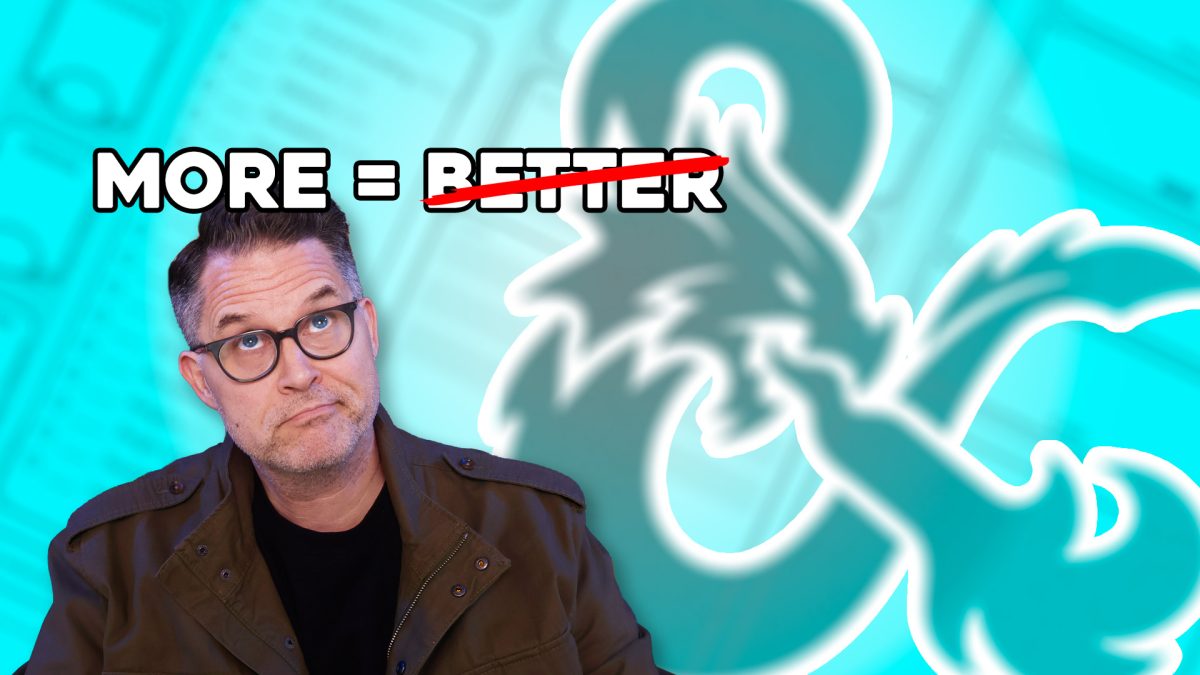
D&D Has Too Many Options (And They’re Ruining Your Game)
We’ve all seen it happen at the table. You’re in the middle of a high-stakes combat encounter. It’s your Fighter’s turn. You expect them to do something heroic – swing from a chandelier, tackle an enemy into a pit, or flip a table for cover. Instead, they stare down at their character sheet for two full minutes, scan 25 different active abilities, and quietly say: “I guess I’ll just shoot my bow again.”
Watch the video: YouTube
Listen on the go: Apple Podcasts | Spotify | Web
Read it here ⬇️
It’s easy to blame distracted or uninspired players, but the real culprit may not be the person sitting across from you but the game system itself. Modern D&D gives players an overwhelming buffet of options, and while that sounds like freedom on paper, it’s actually stifling table creativity.
The Hidden Danger of Choice Overload
In psychology, there is a well-documented phenomenon known as choice overload bias. The common assumption is that more options equal more freedom. In reality, an abundance of choices makes decision-making harder, increases anxiety, and leaves us less satisfied with whatever choice we finally make.
Now apply that to a 10th-level 5e character.
Between classes, subclasses, origin feats, fighting styles, weapon masteries, species traits, and spell lists, a single player might be juggling dozens of mechanical options at any given moment.
When a character sheet gets that detailed, two things happen:
- The Character Sheet Becomes a Cage: Players stop looking at the fictional environment you’ve described and start searching their sheet for a pre-written solution. If an action isn’t codified on the paper in front of them, they assume they aren’t allowed to do it.
- Analysis Paralysis Slows the Game to a Crawl: The sheer cognitive load of weighing 20+ optimal tactical moves turns a simple skirmish into a slow-paced math problem.
Options aren’t inherently bad, but too many options don’t expand creativity – they cage it.
4 Tips to Bring Creativity Back to Your Table
If you’re feeling frustrated by sluggish games or players who run their characters strictly off their sheets, you don’t have to abandon your current campaign. Here are four quick GM techniques to break the cycle:
1. Ask Leading Questions
When players default to basic, uninspired actions, remind them of their environmental freedom. Instead of asking “What do you do?”, ask “The tavern chandelier is hanging directly over the warlord – do you want to try cutting the rope, or do you want to draw your sword?”
2. Offer Creative Suggestions
If a player is clearly paralyzed by options, throw out a cool cinematic idea. Don’t force it on them or fudge dice, but give them permission to think outside the box – especially if they are new to the hobby.
3. Hand Out Inspiration Like Candy (The “Oprah Method”)
Whenever a player attempts a creative, out-of-the-box action, reward them instantly. Don’t wait for a success – give them Inspiration just for making the attempt. Show your table that cinematic risk-taking is valued over mechanical optimization.
4. Say the Words Out Loud
Explicitly remind your group: “You are not limited to what is written on your sheet. Ask yourself what would be fun, and do that.”
3 Games That Fill the 5e Void (Without the Bloat)
If you’re ready to try a system built from the ground up to eliminate clutter while keeping the fantasy epic, here are three fantastic alternatives:
- Shadowdark: The ultimate antidote to option bloat. It keeps the familiar d20 core mechanic of D&D but restricts options to pure, old-school dungeon-crawling essentials. It’s fast, lethal, and puts environmental problem-solving back at the center of the game.
- Nimble: If you want to keep high-powered, super-heroic fantasy but hate sluggish pacing, Nimble is built for speed. Attack and damage rolls are combined into a single die roll, character sheets are dead simple, and combat moves at lightning speed.
- Draw Steel: If your table demands tactical crunch and deep mechanics, MCDM’s Draw Steel delivers – without inheriting 5e’s rule clutter. It replaces bloated option lists with an intuitive, resource-driven gameplay loop that makes every choice feel impactful and fast.
Join the Adventurer’s Guild on Patreon to get access to my personal campaign notes, a library of Dyson Logos maps, and my exclusive, unedited interviews with creators like Nimble designer Evan Diaz.
If you purchase any products linked on our website, we may receive an affiliate commission.