
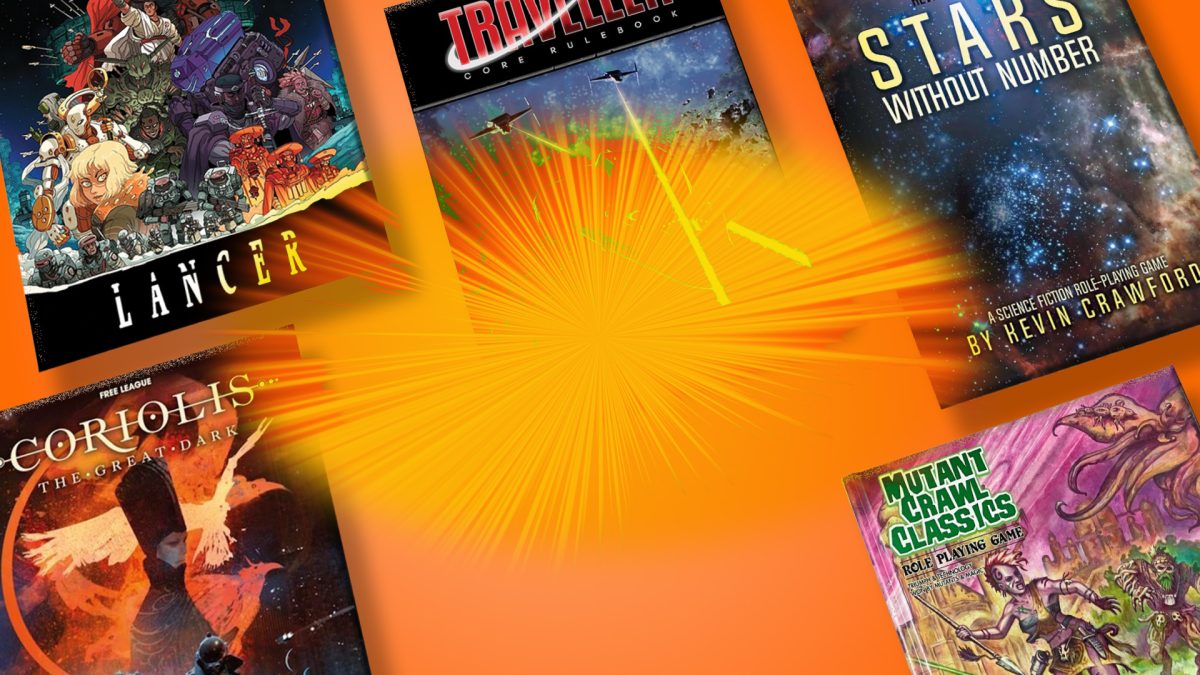
5 Sci-Fi RPGs Worth Skipping D&D For
If you’re tired of repetitive traditional fantasy loops and wading through bloated rulebooks, shifting your campaign into the cosmos gives you high-stakes space exploration, tactical mech combat, and gritty survival without the standard D&D tropes.
- Watch the video: YouTube
- Listen on the go: Apple Podcasts | Spotify | Web
- Read it here ⬇️
Dungeons and Dragons is a classic, but sometimes your table needs to shake things up. There is a massive multiverse of incredible game design out there, and these 5 science fiction TTRPGs prove you don’t have to limit your table to just one genre.
The games on this list range from old-school to crunchy, and dark to bonkers. I guarantee you won’t regret skipping a D&D session to play one of these, and you might just find a new favorite.
Buy TTRPG Books and Accessories | More Game Content
5. Mutant Crawl Classics (MCC)
Goodman Games’ reimagining of the classic TSR game Gamma World brings gonzo, post-apocalyptic chaos to your table.
- Built on the DCC System: It is a standalone game that is fast and easy to learn, yet completely compatible with its pulp fantasy big brother.
- The 0-Level Funnel: It retains the brutal 0-level character funnel, burning luck, and swinging combat tables that fans know and love.
- Genotype Classes: You choose a genotype – Pure Strain Human, Mutant, Manimal, or Plantient (sentient plant life). For everyone but humans, your genotype is your class.
- Super-Science: Characters become more mutated over time and can discover ancient everyday artifacts with crazy, advanced names.
4. Coriolis: The Great Dark
An exploration-focused space opera deeply inspired by 19th-century explorers, deep-sea diving, and pulp archaeology.
- The Lost Horizon: Humanity lives in Ship City – a station built out of an asteroid – and travels via Greatships through a cosmic phenomenon called the Slipstream.
- Year Zero Engine: Built on a quick, flavorful d6 dice pool system where you shoot for 6s and push rolls at the risk of rolling 1s.
- Dedicated Delve Mechanics: Exploration feels like tight, tense spelunking. Parties divide into five distinct expedition roles with special maneuvers that dictate how you move through ruins.
- The Blight: GMs get fantastic delve-building tools to design ancient ruins, where players face horrors and take direct harm from a corrupting cosmic force.
3. Traveller
A legendary sandbox full of far-future space opera tropes that is anchored by a surprisingly hard, simulationist science-fiction center.
- Granular and Procedural: The current edition (2E) updates the 1977 classic for modern gamers, removing the literal orbital math equations while keeping the crunchy, procedural spirit alive.
- Skill-Based 2d6: It trades d20s for a 2d6 system layered with situational modifiers and real-world skills like Admin, Leadership, Military Tactics, and Physics.
- Task Chains: You roll Task Checks under pressure, which can link together so that the success or failure of one check directly impacts the next modifier in line.
2. Stars Without Number
Buy: PDF
The perfect structural bridge between old-school old-school vibes and modern sandbox gaming design.
- The Hybrid System: It uses a 2d6 roll for skill checks outside of combat to give characters consistent, dependable abilities, but switches to a swinging d20 for combat to keep fights random, scary, and brutal.
- Active Space Combat: Non-bloated starship mechanics keep every single player involved in unique shipboard roles (piloting, gunnery, etc.) without overwhelming crunch.
- World-Building Tools: GMs get a step-by-step process with random tables to procedurally generate sector hex maps, complete with randomized planets and distinct narrative tags.
1. Lancer
The ultimate tactical experience for anyone who grew up loving Robotech or Gundam, letting you play an elite mech pilot fifteen thousand years in the future.
- The Split Identity: It masterfully pairs rules-light narrative play outside of your suit (resolving actions simply on a 10+ using a d20 with an incredibly deep tactical combat engine inside the cockpit.
- Super-Crunchy Combat: Mech combat plays out like a chess match where you level up and reallocate specific frame metrics: Hull, Agility, Systems, and Engineering.
- Massive Customization: Features 30 distinct mech frames ranging from 9 to 45 feet tall, supporting two to six legs, organic parts, teleportation, and weapons ranging from railguns to thermal swords.
The Verdict
Every single game on this list brings a special mechanic to the table – whether it’s clever starship management, mutation tables, or faction rules – that any veteran player will appreciate.
What sci-fi games do you love? Let me know your thoughts in the comments below.
If you want to look at my raw session notes, get access to full unedited interviews with game designers, or download my personal library of licensed Dyson Logos maps, consider supporting Short Rest Studios by joining the Adventurer’s Guild on Patreon.
If you purchase any products linked on our website, we may receive an affiliate commission.